hvec: measuring vector compression where it matters
Vector databases quantize embeddings to save memory, and the papers that introduce those quantizers, from product quantization [1] onward, report recall@k against an exact search. That is the right metric for a search engine, and it is how the field benchmarks itself [4]. It is an indirect metric for a retrieval-augmented generation (RAG) system [3], where the retrieved passages are consumed by a language model that may or may not notice a slightly worse ranking. ScaNN made a version of this argument one level down, measuring quantization error by its effect on ranking rather than on reconstruction [2]. hvec moves it one level up, to the answer.
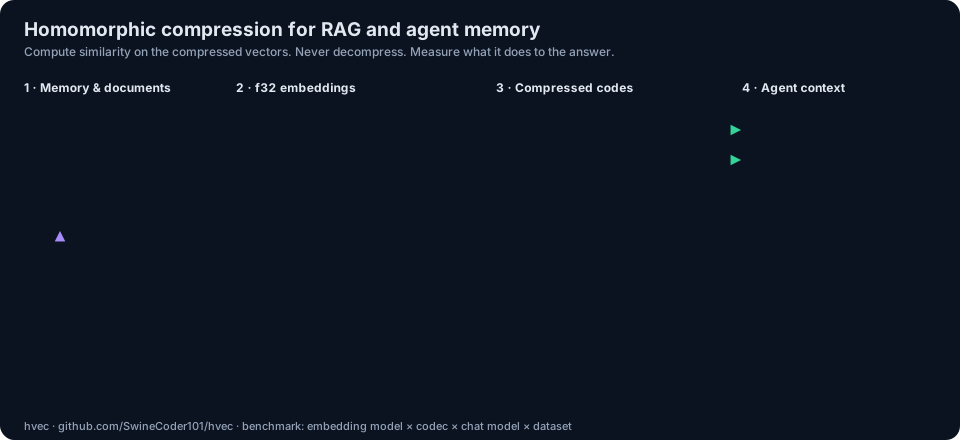
hvec exists to measure the direct thing: run the same questions through the same pipeline with different codecs and different chat models, and compare the answers, the latency, and the token cost. The benchmark is a matrix of embedding model × codec × chat model × dataset. Compression behaviour depends on the embedding model. Tolerance to degraded retrieval depends on the chat model. Both axes are recorded on every run.
What milestone 1 ships
- A Cargo workspace with a
Codectrait whosescoremethod works on the compressed form. Only the f32 baseline exists so far; it is the thing every other codec will be measured against. - Connectors for Anthropic, any OpenAI-compatible server (OpenAI, Ollama, vLLM), and local ONNX embeddings (BGE small by default [6]), all behind named profiles in a TOML config.
- A SQLite store that scores through the codec by brute force. Deliberately no index such as HNSW [5]: the point is to measure the codec, not the ANN structure.
- An interactive shell. Type
hvec, point it at a folder with/new docs ./docs, ask questions, switch models with/model, and every turn lands in a run log with timings, tokens, retrieved chunk ids and the prompt version.
What comes next
Int8 and binary codecs selectable per collection, then product quantization, then a bench
command that runs a question set across the matrix and a report that summarises the log. The
first published experiment will be int8 and binary against f32 on a few hundred QA pairs with a
small local embedding model and two chat models. Generation-side scoring will start with exact
match and add faithfulness in the RAGAS sense [7], graded by a cheaper model with the usual
caveats about LLM judges [8].
Jargon used here is defined in the glossary.
If that sounds useful, the repository is at github.com/SwineCoder101/hvec and contributions are welcome.
References
- Hervé Jégou, Matthijs Douze, Cordelia Schmid. Product Quantization for Nearest Neighbor Search. IEEE Transactions on Pattern Analysis and Machine Intelligence 33(1), 2011. library
- Ruiqi Guo, Philip Sun, Erik Lindgren, Quan Geng, David Simcha, Felix Chern, Sanjiv Kumar. Accelerating Large-Scale Inference with Anisotropic Vector Quantization. International Conference on Machine Learning (ICML), 2020. library
- Patrick Lewis, Ethan Perez, Aleksandra Piktus, Fabio Petroni, Vladimir Karpukhin, Naman Goyal, Heinrich Küttler, Mike Lewis, Wen-tau Yih, Tim Rocktäschel, Sebastian Riedel, Douwe Kiela. Retrieval-Augmented Generation for Knowledge-Intensive NLP Tasks. Advances in Neural Information Processing Systems (NeurIPS), 2020. library
- Martin Aumüller, Erik Bernhardsson, Alexander Faithfull. ANN-Benchmarks: A Benchmarking Tool for Approximate Nearest Neighbor Algorithms. Information Systems 87, 2020. library
- Yury A. Malkov, Dmitry A. Yashunin. Efficient and Robust Approximate Nearest Neighbor Search Using Hierarchical Navigable Small World Graphs. IEEE Transactions on Pattern Analysis and Machine Intelligence 42(4), 2020. library
- Shitao Xiao, Zheng Liu, Peitian Zhang, Niklas Muennighoff. C-Pack: Packed Resources For General Chinese Embeddings. arXiv:2309.07597, 2023. library
- Shahul Es, Jithin James, Luis Espinosa-Anke, Steven Schockaert. Ragas: Automated Evaluation of Retrieval Augmented Generation. arXiv:2309.15217, 2023. library
- Lianmin Zheng, Wei-Lin Chiang, Ying Sheng, Siyuan Zhuang, Zhanghao Wu, Yonghao Zhuang, Zi Lin, Zhuohan Li, Dacheng Li, Eric P. Xing, Hao Zhang, Joseph E. Gonzalez, Ion Stoica. Judging LLM-as-a-Judge with MT-Bench and Chatbot Arena. Advances in Neural Information Processing Systems (NeurIPS), 2023. library
Terms used above are defined in the glossary.